Guide to Buying a Harmonium

When buying a harmonium you can narrow your choice by deciding what options you want. Basic choices are:
1) Regular vs. Portable
Portable harmoniums fold up into a suitcase-like box ½ to 2/3 of their regular height. There is a handle in front so they can be carried with one hand like a suitcase. If you are traveling around a lot with your instrument this is an attractive option, since it’s lot easier to carry a harmonium this way than by the two side handles of a regular harmonium. If you’re not, then it’s just another moving part. In general, you sacrifice no sound by getting a portable.2) Regular vs. Scale Change
Scale change harmoniums have a mechanism that allows you to slide the keyboard up to four half steps left or right. So if you are used to always playing in B flat, and the song is in C, you just shift the keyboard up two half steps. This is not a feature you need if you can play easily in different keys, or if you will always be playing in the same key.On the other hand, some proficient keyboard players have told us they prefer to always play from B flat because of the way their hand sits on the keys in that position (harmonium keys being smaller than piano keys). Keep in mind that what most makers consider their best instrument is a three reed scale change model.
3) Double Reed vs. Triple Reed
Most harmoniums have two or three sets of reeds per note. See below for how these reeds can be voiced. Double reed instruments can be great, and all you need. A triple reed instrument will give you a fuller sound and more flexibility.4) Full Size or Smaller
Most makers make some models that are slightly smaller and lighter than what is considered a normal size instrument. These are usually double reed, non scale-change harmoniums. The Bina 23b is an example of this style. These instruments often suffice for one voice.HARMONIUM SPECS
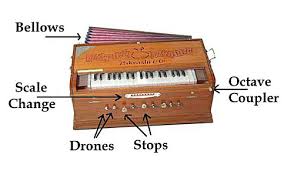
Stops
Drones
Reeds
Harmonium reeds are made of copper or brass. They are similiar in construction to accordion reeds. Generally, reeds come in 3 different voicings covering 3 different octaves – bass, male, and treble (sometimes called female). Bass reeds are obviously the lowest. Male reeds are an octave higher, and treble reeds one more octave up. A double reed instrument will usually be voiced B/M or M/T . A triple reed instrument can be voiced B/M/M or B/M/T or M/M/T. Different voicings produce harmoniums with different timbres and sustain.Bass reed require more air, so a B/M/T instrument will have less sustain than a M/ M/ T instrument, but will be louder.
Comments
Post a Comment